The Tools Are Fine. The Organization Isn’t.
by Allan Kyle
I’ve spent most of my career around large technology implementation programs. Some delivered on objectives. Some did not.
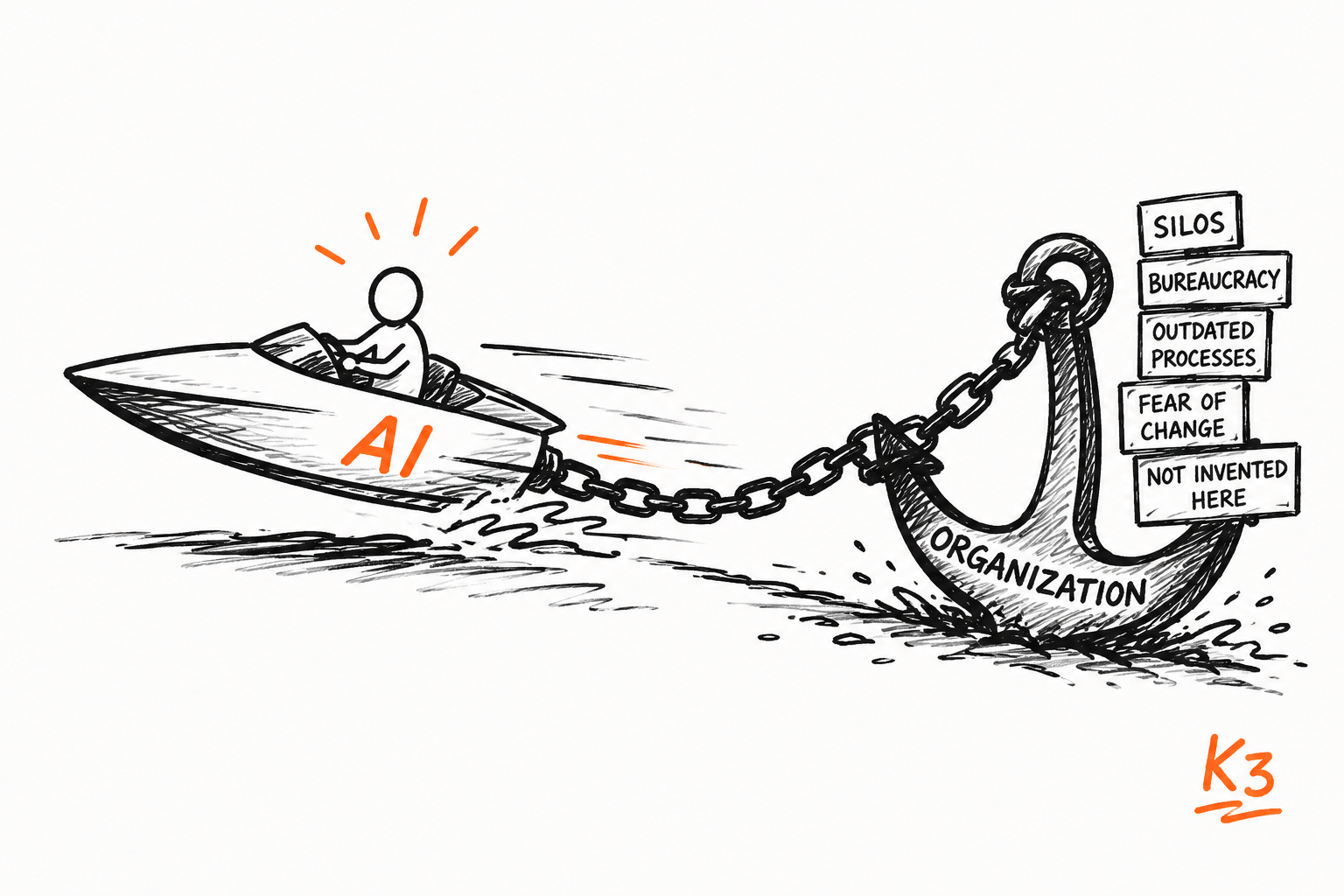
Even before the final review, you could usually tell if a technology project was going to fail – though at that point, nobody was eager to pipe up and say that. The company had already invested in system. The implementation team was ready to go. The users were engaged. The pilot looked good.
The problem though, was that the company expected the technology to force change to the business without committing to changing much about the business itself.
I saw versions of this with huge investments in ERP, Planning and Analytics that ran into the wall of organizational acceptance. Now, at Keel3, I’m seeing the same pattern with AI.
There are levels to how a company brings in AI, and they have vastly different outcomes..
The first is to give AI tools to people. Everyone gets a license and finds ways to save themselves time. The second is to incorporate it into existing processes, so the same workflow runs faster or with fewer hands. Both make the company more efficient. Neither changes what the company actually does.
Companies are buying licenses, launching pilots and asking employees for use cases. There are assessments, roadmaps, steering committees and training sessions. There is plenty of activity.
The results are real, are quantifiable: But in many companies, not much is actually different. A team produces a report faster;. Someone saves a few hours building a presentation; Customer service drafts replies more quickly; “we have chatbot on our website”. But in most companies, nothing has actually changed about the business. The results are useful, yes. Transformational, no.
The companies doing this best are operating on a third level. They’re rethinking the process around what AI can now do, and what information it uses, instead of speeding up the process you already had. That is the level where a company gets more effective, not just faster. It is also the only one of the three that requires changing the organization — which is why most companies stop at the first two.
I firmly believe that in the next 1-2 years, we will clearly see the difference in results between companies that take each of the three paths, that fully embrace the power of their people, and execute at speed.
The Company Doesn’t Know What Its People Know
AI gets more useful when it has access to the context behind the work.
-
Why was this decision made?
-
What happened the last time?
-
Which customer issue keeps coming back?
-
Which report looks right but cannot be trusted?
This knowledge lives in inboxes, old decks, meeting notes and people’s heads. So most companies cannot answer these questions in a form AI can use.
The most critical information is usually the items that fall through the cracks, don’t fit the standard or don’t neatly fit in into a spreadsheet. One employee knows why a large customer nearly left. Another knows which monthly number needs to be adjusted. Someone else knows why an inefficient process has never been changed.
When those people leave, part of the company leaves with them. That has always been a problem, butAI makes it harder to ignore. An AI system can’t use knowledge the company doesn’t capture. The companies that pull ahead will be the ones that get better at keeping what they learn.
The companies that capture institutional memory start to operate as an intelligent organization: one that learns as it works, rather than relearning the same lessons every time someone leaves. Without that, AI is just another layer sitting on top of the same fragmented business.
I spent years working with Private Equity firms, helping them assess investment targets. We looked at technology, systems, and processes. But a critical aspect was the people side, the organizational knowledge. We worked to understand where the critical knowledge sat and how much of the business was really in people’s heads, whether that could scale to meet investment thesis, and what would happen if some of those people left. I have seen investments of hundreds of millions cancelled because the acquisition target simply wasn’t ready for change, for growth.
Pilots Are Safe. Change Is Not.
A pilot project can prove the technology works without forcing the company to settle the hard questions. That is part of the appeal. A pilot can live inside one team, use a limited set of data and avoid changing who does what. Leaders can point to progress and nobodyhas to remove an approval step or give up control.
Scaling change looks different. People need to change their roles, well established processes are challenged, the organization has to give up some control.:
-
When AI makes a decision, can the employee act on it?
-
Does a manager still need to approve it?
-
What happens when the system’s recommendation conflicts with the most senior person in the room?
These are not really technology questions. They are questions about control.
Companies often respond to this discomfort by asking for another round of testing the pilot. Sometimes that is necessary. Sometimes it is easier than admitting the technology pilot exposed a human challenge. A step may no longer be needed. A manager may be approving work without adding much. Information that used to belong to one group is now available to everyone.
I once helped a Fortune 500 company finally build an analytical dashboard that looked across all of its product lines and business units. The pilot looked great, and we rolled it out. The organizational pushback was swift. Within weeks the project was cancelled and the system was shut down. Within months the entire analytics team had been restructured. The system worked fine. What it revealed about the organization was not, and the company had to make a choice.
Time and again, the pilot stays a pilot because the technology is easier to change than the organization.
Nobody Wants to Own the Bad Outcome
Accountability is another issue companies leave vague for too long.
-
If AI helps make a bad decision, who owns it?
-
The employee who used it?
-
The manager who approved it?
-
The team that selected the system?
-
There has to be an answer before people will trust AI with meaningful work. In many companies, there is not one yet. Employees are told to experiment, while also being warned about privacy, accuracy, security and compliance. The warnings are reasonable. The rules often are not clear enough. So people make up their own.
Some use AI quietly and do not mention it. Some check the accuracy of every sentence so carefully they save almost no time. Others stay away because the personal risk feels greater than the likely benefit.
Leaders may call that resistance. Often, it is self-protection.
Buying AI Is the Easy Part
The companies making real progress are doing more than encouraging people to use AI.
-
They are deciding what knowledge matters and who owns it.
-
They are looking at where decisions get stuck.
-
They are setting boundaries around what AI can do, what still requires judgment and who is responsible for the result.
-
They are also removing steps that no longer serve a purpose.
This is the third level: redesigning the work, not just accelerating it. That work reaches into process, management, incentives and authority. It is harder than buying software, but it is also where the value is.
The lasting advantage will not come from having earlier access to a particular model. Models will keep changing. Features that seem distinctive today will become common. The harder thing to copy is an organization that knows how to retain what it learns and leverage that knowledge into the new technology.
Most leadership teams have already decided to invest in AI. The harder question is whether they are willing to change the company enough for the investment to matter. The tools are fine. The organization around them is where the work begins.