I Didn’t Have Time to Write a Short Message, So I Had AI Create a Long Report
Patrick Callahan - Keel3
An Action Plan for Managers to Reclaim Meeting Time and Get Better Results from AI
The Problem We’re Not Talking About, Yet
Pascal wrote in 1657: “I have made this longer than usual because I have not had time to make it shorter.” Nearly 400 years later, we’ve automated the problem.
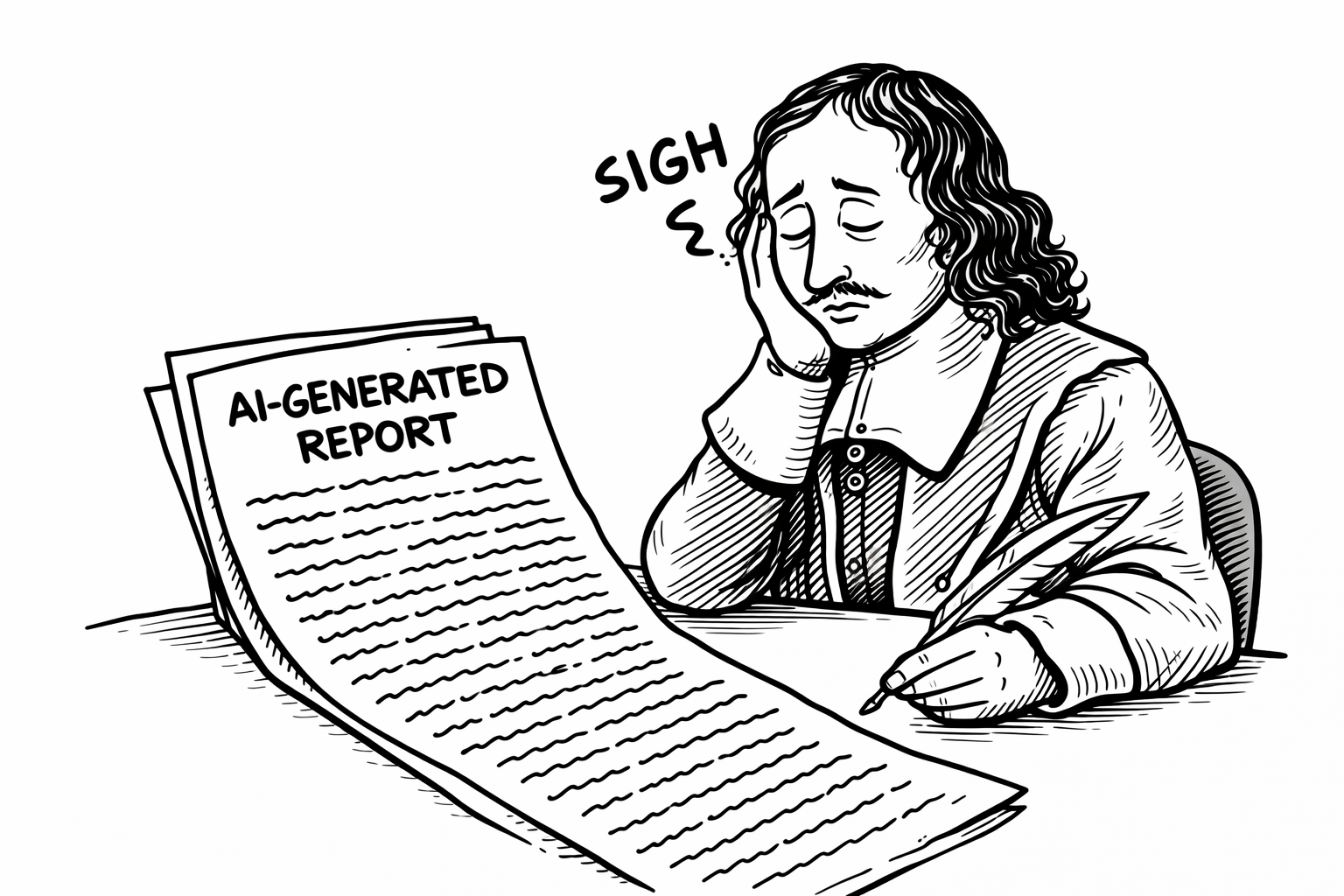
According to Microsoft’s 2024 Work Trend Index, 75% of knowledge workers now use AI at work, with adoption doubling in just 18 months. But here’s what the surveys don’t capture: your meetings are getting longer, your team’s presentations are getting more elaborate, and you’re somehow making fewer decisions than before.
The issue isn’t the technology. It’s that we’re using AI to generate the wrong deliverables. Your team is producing AI-generated slide decks and reports that look polished but lack depth, creating what researchers call “productivity theater” - impressive materials that actually slow down decision-making rather than accelerate it.
As a manager, you can change this. Here’s how to guide your team toward AI usage that actually shortens meetings and sharpens thinking.
1. Teach Them to Mine Data, Not Summarize It
The Bad Habit: Your team member dumps a spreadsheet into ChatGPT and asks it to “analyze this data and create a summary.” They get back three pages of obvious observations written in corporate-speak.
The Better Approach: Train your team to use AI for pattern recognition and anomaly detection, not passive summarization.
Prompts That Actually Work:
For trend analysis:
“Analyze this sales data and identify any patterns that contradict our assumptions about seasonality. Focus on anomalies, not averages.”
For comparative analysis:
“Compare these two quarters and tell me specifically what changed in customer behavior, not just what the revenue numbers were. What hypotheses would explain these changes?”
For diagnostic work:
“This metric dropped 15% in March. Generate five plausible root causes ranked by likelihood based on the data patterns, then tell me what additional data would confirm or eliminate each hypothesis.”
Your Role: In your next team meeting, when someone presents AI-generated analysis, ask: “What surprised you in this data?” If they can’t answer, the AI didn’t help them think - it just helped them avoid thinking. Send them back to refine their prompts.
2. Force the Counterargument
The Bad Habit: Team members use AI to articulate their existing idea more persuasively. The AI becomes a yes-man, making weak concepts sound stronger than they are.
The Better Approach: Require AI-assisted devil’s advocacy before any significant proposal.
Prompts for Intellectual Honesty:
For proposal stress-testing:
“I’m proposing [X strategy]. Take the opposing position and build the strongest possible case against this approach using market data, competitive analysis, and behavioral economics.”
For assumption-checking:
“Here’s my business case for [initiative]. Identify every assumption I’m making and rank them by risk. For the top three riskiest assumptions, what evidence would I need to validate them before proceeding?”
For exploring alternatives:
“I want to solve [problem] with [solution]. Generate three fundamentally different approaches I haven’t considered, including at least one that challenges the premise of the problem itself.”
**Your Role: **Establish a new rule - any proposal over $10K or 40 work-hours requires a one-page “best case against” document created with AI assistance. If someone can’t articulate why their idea might fail, they haven’t thought it through.
3. Prototype Ideas, Don’t Just Pitch Them
This is the critical shift.
For decades, the workflow was: have idea, create PowerPoint, get approval, then see if it actually works. AI tools have eliminated the need for this delay.
The Bad Habit: Your marketing director presents 15 slides about a campaign concept. Everyone nods. Three months later, when the designer delivers the actual materials, you realize the concept doesn’t work.
The Better Approach: Expect working prototypes, not presentations.
What This Looks Like in Practice:
-
Ad campaigns? Use AI image generators (DALL-E, Midjourney, Google Nano Banana, ChatGPT) to mock up the actual ads. Use Claude or ChatGPT to write the copy variations. Show the work, not the strategy deck.
-
New customer program? Use Manus, Open AI’s Codex, Claude Co-work / Claude Code, to build a clickable prototype of the user interface. Let people actually experience the proposed workflow.
-
Process changes? Create a simulation of the new process with realistic scenarios. Walk through what Tuesday morning looks like under the new system. Use tools like Claude with Figma to build a workflow.
-
Product features? Build a functional demo with AI coding assistance. If you can’t prototype it in a few hours, you probably don’t understand it well enough to greenlight it.
Your Role: Start saying “show me, don’t tell me” in meetings. When someone begins a presentation with “I’d like to propose we create…” stop them and ask: “Did you build a prototype?” If the answer is no, the meeting’s over. Come back when you have something people can react to.
This is a cultural shift, but AI makes it possible. You no longer need to wait for design resources or development sprints to test an idea. Your team can move from concept to prototype in the time it used to take to format a slide deck.
4. Create Safe Synthetic Data for Real Testing
The Bad Habit: Great ideas die in meetings because “we’d need customer data to test this properly, but we can’t access that for privacy reasons.”
The Better Approach: Use AI to generate synthetic datasets that preserve statistical properties while protecting privacy.
Why This Matters: Your team can now test database queries, stress-test reports, demo new dashboards, and validate analytical approaches without ever touching real customer information.
Your Role: When someone says “we can’t test this without real data,” push back. Require them to prototype with synthetic data first. This accomplishes two things: (1) they discover whether their idea is analytically sound before touching sensitive information, and (2) they often realize they didn’t need the real data at all.
The Meeting Rule That Changes Everything
Here’s your new standard: If it can be prototyped, it must be prototyped. If it can’t be prototyped, it might not be ready for a meeting.
This doesn’t mean AI does the thinking. It means AI enables your team to think more concretely, test assumptions faster, and present work that can be evaluated on merit rather than presentation skills.
Microsoft’s research also shows that 78% of workers are bringing their own AI tools to work rather than waiting for company-approved solutions. Your team is already using these tools. The question is whether they’re using them to create busywork or to do better work.
Start with one meeting. Tell your team the new expectation: come with prototypes, not presentations. Come with questions the data raised, not summaries of what the data said. Come with the strongest argument against your own proposal, not just the pitch for it.
You’ll know it’s working when your meetings get shorter and your decisions get better.
If this sounds scary to you, but you want to give it a try, let’s talk. At Keel3, we help businesses implement AI in ways that actually improve how work gets done. If your team is generating impressive (read: voluminous) AI outputs but you’re not seeing better results, that’s where we can help. We’ve created a secure environment where your team can experiment, innovate and prototype, without taking on any of the risks described above.
Pascal couldn’t have imagined AI, but he understood the fundamental truth: doing the hard thinking takes time, and it produces shorter, clearer communication. AI can accelerate that hard thinking, but only if you teach your team to use it that way.
Otherwise, you’re just getting longer reports faster.